

Period Blood Colour: What It Means for Your Health

period colour

Noticing changes in the colour of your period blood is common and often a normal part of your menstrual cycle. In most cases, these colour variations are harmless and simply reflect natural hormonal changes, the speed of blood flow, or how long the blood has been exposed to oxygen.

However, there are times when colour changes may point to an underlying issue. This guide outlines what different period blood colours may mean, what’s considered typical, and when it may be time to speak with your GP.

Why Menstrual Blood Colour Changes

Menstrual blood is a mix of blood, uterine lining, and cervical fluid. Its appearance can vary from person to person, and from one cycle to the next. Factors like hormone levels, flow rate, and timing within your cycle can all influence its colour.

Period Blood Colour and What They Mean
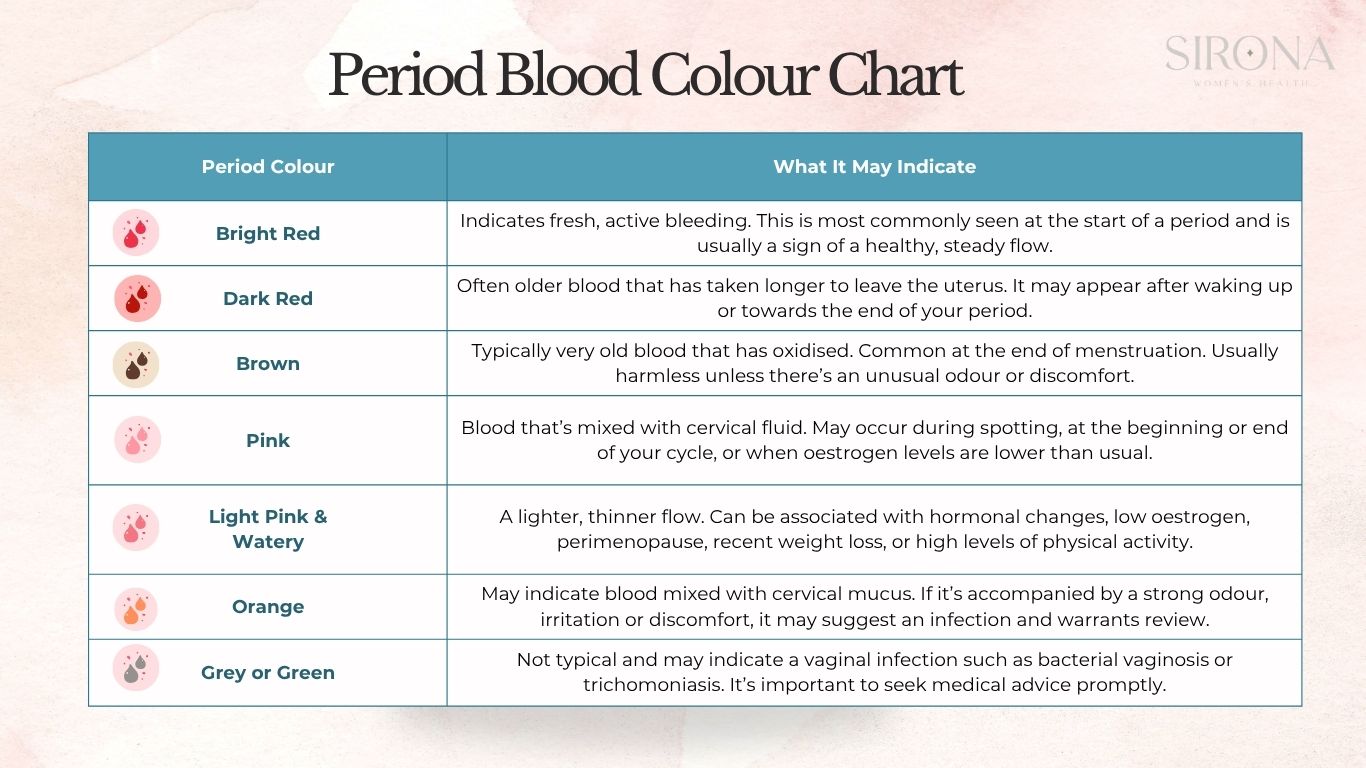
Period Blood Colour Chart

Bright Red Menstrual Blood

Bright red blood is typically a sign of fresh, active bleeding. It usually appears at the beginning of your period when your body is shedding the uterine lining at a steady rate. This type of flow is common during the heaviest days of menstruation.

It’s generally considered healthy and normal. However, if you’re seeing bright red blood outside of your usual period such as between cycles, it may be worth discussing with your GP, as it could be related to spotting, hormonal imbalances, or other conditions.

Dark Red or Brown Blood

Brown or dark red period blood is usually older blood that’s taken more time to pass through the uterus. This often happens when your flow is light such as at the beginning or end of your period. As the blood is exposed to oxygen, it naturally darkens, which is generally nothing to worry about.

You might also notice brown spotting after a missed period or in early pregnancy. However, if it’s happening often outside your usual cycle or comes with unusual discharge or cramping, it’s best to check in with your doctor.

Pink Period Blood

Many people wonder, “Why is my period blood pink?” or “My period blood is light pink and watery should I worry?”

Pink blood is often a sign that menstrual blood has mixed with cervical fluid. This can happen when your flow is light, such as during the start or end of your period, or with light spotting.

If your period is consistently pink, it may point to low oestrogen levels possibly linked to stress, hormonal contraception, or nutritional gaps. It can also appear during ovulation spotting or early pregnancy. If this is a new or recurring pattern, it’s worth discussing with your GP.

Light Pink and Watery Blood

If your period blood is light pink and watery, it might suggest a thin menstrual blood flow, which can be linked to hormonal imbalances or low oestrogen production. This can occur in people who engage in intense physical activity, experience high levels of stress, or have a very low body weight or body fat percentage.

It’s also common in people approaching perimenopause or those with certain underlying health conditions like anaemia or thyroid disorders. While a light, watery period isn’t always a red flag, consistent changes in flow and colour should be monitored.

Orange Period Blood

Orange blood can appear when red menstrual blood mixes with cervical fluids. If there are no other symptoms, this may not be a concern. However, if orange blood is accompanied by unpleasant odour, itching, or irritation, it may indicate an infection such as bacterial vaginosis or trichomoniasis.

It’s important to monitor how long it lasts and whether any other signs of discomfort occur.

Gray or Green Period Blood

Gray or greenish menstrual blood is not normal and can be a sign of a vaginal infection. In particular, grey discharge often indicates bacterial vaginosis. Other symptoms might include itching, strong odour, discomfort, or fever.

If you notice this type of discharge, it’s best to see your GP as soon as possible to rule out infection and start treatment if necessary.

Thin Menstrual Blood: Is It Normal?

Thin menstrual blood that looks more watery than usual can be a result of light flow or low hormone levels. This can happen during lighter periods or as part of hormonal shifts, such as during perimenopause or due to stress, poor diet, or significant weight loss.

In some cases, thin blood may also signal a lack of sufficient endometrial lining buildup, which could affect fertility. If you notice that your period is consistently thinner and accompanied by other symptoms such as fatigue, hair loss, or irregular periods, it may be a sign of underlying period concerns, it’s worth checking in with your GP.

When Should You Be Concerned About Period Blood Colour?

Most of the time, colour changes are part of your body’s natural rhythm. But there are times when it’s worth getting things checked. Reach out to your GP if you notice:

  • Gray or green discharge
  • Unusually watery, thin, or light pink blood over multiple cycles
  • Painful periods with clotting larger than 2.5 cm
  • Spotting between periods
  • Changes in your cycle that persist for more than two months
  • A strong or unusual vaginal odour
  • Bleeding that lasts longer than 7 days

These could be signs of hormonal disorders, infections, fibroids, polyps, or other reproductive health conditions that may need treatment.

What Does It Mean if My Period Starts Brown and Then Turns Red?

Brown blood usually indicates older menstrual blood that has oxidized and taken longer to leave the uterus. This is common at the very beginning or end of your period. As your menstrual flow increases, you’ll notice brighter red blood, which is fresher and shows active bleeding. This pattern is normal and usually not a cause for concern.

Why Is My Period Blood Stringy or Clotted?

It’s not unusual to pass small clots or stringy bits of tissue during heavy days. Clots smaller than 2.5 cm are generally normal and form when the uterus sheds faster than the body can break down the tissue. If clots are large or frequent, or if your flow is very heavy, it’s worth speaking to your doctor to check for conditions like fibroids or hormonal imbalances.

Can Stress or Diet Affect My Period Blood Colour?

Yes. High stress levels, significant weight loss, very low body fat percentage, or restrictive diets can lower estrogen levels. This hormonal change can cause your period blood to be lighter, thinner, or pink-tinged. These factors can also impact your menstrual cycle regularity and flow intensity.

Is It Normal for My Period to Be Light Some Months and Heavy Others?

Fluctuations in period heaviness are common and can be influenced by stress, travel, illness, medication changes, or natural hormonal shifts. However, if you experience sudden, extreme changes in flow or duration that last more than two consecutive cycles, or if you have bleeding that lasts longer than 7 days, it’s best to speak with your GP to check for any underlying health concerns.

Can Birth Control Change the Colour of Your Period?

Yes. Hormonal contraceptives including pills, patches, injections, and hormonal IUDs, can alter your menstrual bleeding pattern. This often results in lighter bleeding, spotting, or changes in blood colour such as pink or brown spotting between periods. These changes are usually harmless but should be discussed with your healthcare provider if they cause concern.

Supporting Your Menstrual Health at Sirona Women’s Health

Your menstrual cycle can offer helpful insights into your overall wellbeing. While colour changes like red, brown, or pink are often normal, it’s important to stay aware of what’s typical for your body and seek advice when something doesn’t feel right.

At Sirona Women’s Health Clinic in Brisbane, our all-female GP team is here to support you through all stages of your reproductive health. Whether you’re experiencing irregular periods, heavy bleeding, or conditions like PCOS or endometriosis, we offer personalised, compassionate care to help you feel your best.

Disclaimer: This information is intended for educational purposes and should not replace professional medical advice. Please speak with your doctor about your individual symptoms or concerns.

Take the first step towards better health

At Sirona Women’s Health, we’re dedicated to providing you with the personalised, high-quality care you deserve. Our experienced all-female clinic, serving Annerley and the Greater Brisbane area, is ready to listen, support, and empower you through every stage of your healthcare journey.

INTRODUCTION

This privacy policy is to provide information to you, our patient, on how your personal information (which includes your health information) is collected and used within our practice, and the circumstances in which we may share it with third parties. Our obligations are set under the Privacy Act 1988.

WHAT IS PRIVACY?

As an individual, the Privacy Act grants you enhanced authority over the management of your personal data. Under the Privacy Act, you have the right to:

  • Understand the purpose behind the collection of your personal data, its intended use, and who will have access to it.
  • Opt not to disclose your identity or to use an alias in specific situations.
  • Request access to your personal data, including health information.
  • Cease receiving unsolicited direct marketing communications.
  • Request correction of any inaccuracies in your personal information.
  • Lodge a complaint against an organization or agency covered by the Privacy Act if you believe they have mishandled your personal information.

WHY AND WHEN YOUR CONSENT IS NECESSARY

By becoming a patient at our practice, you grant consent for our general practitioners and practice personnel to access and utilize your personal data to deliver optimal healthcare services. Access to your personal information will be restricted to staff members who require it for your care. Should there arise a necessity to utilize your information for purposes beyond healthcare provision, we will obtain your explicit consent beforehand.

HOW CAN YOU LODGE A PRIVACY RELATED COMPLAINT AND HOW THE COMPLAINT WILL BE HANDLED AT OUR PRACTICE

We treat privacy-related complaints and concerns with utmost seriousness. We encourage you to communicate any privacy issues you may have in written form. Subsequently, we will endeavor to address and resolve them in accordance with our established resolution procedure. Complaints can be forwarded to our Practice Manager delivered to 1/720 Ipswich Road, Annerley 4103. You may also wish to have a confidential chat with our Practice Manager beforehand. Our Practice Manager can be reached by phoning our practice during business hours – Monday – Friday. All complaints are likely to be responded to and actioned within 2 business days.

WHY DO WE COLLECT, USE, HOLD AND SHARE YOUR PERSONAL INFORMATION

To deliver healthcare services effectively, our practice requires the collection of your personal information. Our primary objective in collecting, utilizing, storing, and managing your personal data is to oversee your healthcare needs. Additionally, we employ this information for associated business activities, including financial transactions, practice evaluations, accreditation processes, and operational functions such as staff training.

DEALING WITH OUT PRACTICE ANONYMOUSLY

You possess the right to engage with us anonymously or under a pseudonym, unless such actions are deemed impractical, or unless legal obligations or authorizations necessitate interaction solely with identified individuals.

WHAT TYPES OF INFORMATION DO WE COLLECT?

Your doctor relies on information regarding your past and present health to deliver quality care. Data pertaining to your health, medical history, or anticipated medical treatments is termed “personal health information” if it enables someone to identify you.

Our practice adheres to the Guidelines on Privacy in the Private Health Sector outlined by the Office of the Federal Privacy Commissioner. This commitment ensures the confidentiality and security of your personal health information.

We maintain a documented policy outlining the handling of your personal health information, which is accessible to all patients for review.

The information we collect encompasses:

  • Names, date of birth, addresses, and contact details
  • Medical details including medical history, medications, allergies, adverse events, immunizations, social history, family history, and risk factors
  • Medicare number (where available) for identification and claiming purposes
  • Healthcare identifiers
  • Health fund details

HOW WE COLLECT YOUR PERSONAL HEALTH INFORMATION

Our practice may gather your personal information through various channels:

  • During your initial appointment, our staff will collect your personal and demographic details as part of the registration process.
  • Throughout the provision of medical services, we may gather additional personal information.
  • Your personal information may also be obtained when you interact with us via our website, email, SMS, telephone calls, online appointments, or social media.
  • In certain situations, personal information may be sourced from other avenues, as it may not always be feasible or reasonable to collect it directly from you. This may involve information obtained from your guardian or responsible person, other healthcare providers involved in your care (such as specialists, allied health professionals, hospitals, community health services, pathology, and diagnostic imaging services), as well as pertinent information from your health fund, Medicare, or the Department of Veterans’ Affairs when necessary.

PRIVACY AND ELECTRONIC COMMUNICATIONS

Our practice frequently receives communications via email, however in order to adhere to Australian Privacy Principals and ensure a more efficient and reliable service for our patients, we have transitioned away from email as our primary form of communication.

It’s important to note that our practice also does not engage in communication with patients via social media. We have implemented a social media policy to ensure adherence to professional standards. If you would like a copy of this policy, please inform our reception staff.

Our patients are still able to submit non-urgent enquiries via email or via our website however depending on the nature of the enquiry, should expect a 2 day turn around. For more urgent matters, we encourage our patients to phone our Practice during business hours – Monday-Friday.

Privacy is a priority for us, even on our website. Here’s how we ensure your privacy is respected:

  • Secure Connection: Our website is encrypted to protect your data when you interact with us online.
  • Limited Data Collection: We only collect necessary personal information on our website, and we’re transparent about what we collect and why.
  • Data Protection Measures: We employ robust security measures to safeguard any information you provide on our website from unauthorized access or misuse.
  • Third-Party Policies: If our website uses third-party services (like analytics or social media plugins), we ensure they also prioritize user privacy.
  • Cookie Policy: We inform you about our use of cookies and give you options to manage your preferences.
  • Clear Communication: We’re upfront about our privacy practices and provide easy-to-understand

WHERE WE STORE AND PROTECT PERSONAL HEALTH INFORMATION

This practice utilizes electronic records for efficient management of patient information. Any physical documents such as specialist letters, X-rays, CT scans, and pathology results received via post are securely stored away from public view until they are scanned into our computer system. Once the necessary actions have been taken, these documents are securely destroyed following appropriate protocols.

To ensure the security of personal health information, our practice implements various measures including screen savers, passwords, anti-viral software, firewalls, regular data backups, and maintenance routines.

Your doctor is committed to maintaining the integrity of your medical record, ensuring that it is:

  • Accurate, comprehensive, well-organized, and legible
  • Up-to-date
  • Sufficiently informative for another healthcare provider to deliver care
  • Free of offensive or irrelevant remarks
  • Includes a summary of your care
  • Can be used, with your permission, to remind you of follow-up appointments, checkups, and reviews

Your doctor will only collect information that is pertinent to your medical care. If you have any concerns or questions regarding the information being requested, don’t hesitate to ask your doctor for clarification.

WHEN, WHY AND WITH WHOM DO WE SHARE YOUR PERSONAL HEALTH INFORMATION

We occasionally share your personal information in the following circumstances:

  • With third parties collaborating with our practice for business purposes, such as accreditation agencies or information technology providers. These third parties are obligated to adhere to the Australian Privacy Principles (APPs) and our privacy policy.
  • With other healthcare providers involved in your care.
  • When required or authorized by law, such as in response to court subpoenas.
  • In situations where it is necessary to mitigate or prevent a serious threat to a patient’s life, health, or safety, or to public health or safety, or when obtaining the patient’s consent is impractical.
  • To aid in locating a missing person or to establish, exercise, or defend a legal claim.
  • For confidential dispute resolution processes.
  • When statutory requirements mandate sharing certain personal information, such as mandatory notification of certain diseases.
  • As part of providing medical services, including through electronic transfer of prescriptions and My Health Record.
  • When booking appointments online via Hotdoc.

Access to your information is restricted to individuals who require it for legitimate purposes. Outside of providing medical services or as outlined in this policy, our practice will not share personal information with any third party without your written consent.

We will not disclose your personal information to entities outside Australia (except under exceptional circumstances permitted by law) without your written consent. Our practice will refrain from using your personal information for direct marketing of our goods or services without your explicit consent. If you do consent, you retain the right to opt out of direct marketing at any time by notifying our practice in writing.

Your personal information may be utilized by our practice to enhance the quality of services we offer through research and analysis of patient data. We may provide de-identified data to other organizations to improve population health outcomes. This information is securely stored within Australia, and patients cannot be individually identified. If you prefer not to have your information included, please inform our reception staff.

HOW YOU CAN ACCESS AND CORRECT YOUR PERSONAL HEALTH INFORMATION

You have the right to access the information contained in your medical record. We believe that sharing information fosters good communication between you and your doctor, promoting optimal healthcare.

Upon request, your doctor can provide you with an accurate and up-to-date summary of your care, such as when you are relocating and transitioning to a new healthcare provider. Feel free to ask your doctor for a summary of your care for any reason. If you request access to your full medical record or a summary, your doctor may need to redact any information provided by others on a confidential basis.

Your doctor must also consider the potential risk of physical or mental harm to you or others that could arise from disclosing your health information. While there are circumstances where access may be denied, you will be informed of the reasons if this occurs. In most cases, your doctor will gladly provide a thorough explanation of the health summary or medical record provided. Please note that a small but reasonable administration fee may be charged for such access, as well as the time spent with your doctor.

If you discover that the information in your record is inaccurate, incomplete, or outdated, our practice will take reasonable steps to rectify it. We may periodically ask you to confirm that your personal information held by our practice is correct and current. Additionally, you can request corrections or updates to your information by submitting written requests to our practice via email.

We do not recommend erasing information from your record, as this may lead to incomplete documentation.

POLICY REVIEW STATEMENT

This privacy policy undergoes regular review to ensure alignment with any changes that may arise. A copy of the most recent version of the privacy policy will always be accessible at the reception desk for your reference.

Please write your details as they appear on your Medicare Card.
Birth Sex
I identify as
Pronouns
Marital Status
Are you of Aboriginal or Torres Straight Islander decent?
Sirona Women’s Health acknowledge the Traditional Owners and Custodians of the lands on which we work and pay our respects to Indigenous Elders past, present and emerging.
Preferred contact method
I hold a current and valid
Colour
Do you consent to Sirona Women’s Health sending you SMS reminders for your upcoming appointments/clinical reminders?
I authorise Sirona Women’s Health to contact my NOK/ Emergency contact if needed.
Do you consent to Sirona Women’s Health contacting you via email?
I acknowledge that I have read and comprehend the practice privacy brochure (copy found on our website).